During the Rev Patrick Clason’s ministry in Carmunnock from 1815-24, the church’s gate-house was built. At that time resurrectionists prowled in churchyards digging up graves, stealing newly buried corpses and selling them to certain teachers of Medicine who practised illegally in the use of stolen bodies for morbid anatomy.
Carmunnock churchyard too was invaded by body-snatchers and the gate-house with its fireplace and chimney and its narrow slits in the stonework for surveying the graveyard, was built to shelter the guards posted there to prevent this ghoulish vandalism. The guards consisted mainly of elders responsible for the churchyard and church property, and the board dated 1828 still hanging in the gate-house today, is inscribed with Orders for the Watch and reads:
“There are two on Watch each night, who are to go on an hour after sunset and continue till after daybreak in winter and till after sunrise in summer. They are strictly prohibited from getting intoxicated or leaving the churchyard during that time, and no visitor is allowed to enter on any account without giving the password for the night. They are also prohibited from making noise or firing guns, except when there is cause of alarm that any of the inhabitants in such cases may be able to turn out to the assistance of the Watch. Any damage that may be done to the Watch-house or to the furnishings is to be repaired at the expense of those who make it.”
Ordered at Carmunnock on 8 Jan. 1828
So terrified at this time were the bereaved that their newly buried relatives’ graves might be interfered with, that they too sometimes watched. The Rev Patrick Clason quoted a case, not thought to be of Carmunnock, where the family was so wrought with anxiety that the eccentric younger sister of the deceased made her bed each night at the graveside until such time as the body had lain long enough not to interest the thieves.
About 1837 a new Manse replacing those of 1744 and 1788 was built in grounds on the south side of Manse Brae, with stables and outbuildings for farm animals; and they grazed on the Manse’s two Glebe fields, north and south of the Ditch. Like other villagers, at that time it was quite usual for the minister to keep cows, pigs and poultry as well as his horses - possibly even some sheep to crop the grass on the Manse’s extensive lawns.
For many years there had been a succession of schoolmasters at the little school in the Loan. Perhaps this was because the salary paid by the church was so meagre. Then in 1803, by an Act of Parliament a law was passed whereby schoolmasters must be paid a minimum of 300 and a maximum of 400 merks Scots (between £16 and £22) annually.
Two or three years after the Manse, the church heritors built a new and much more commodious school on farmer Boag’s land in the village. Presumably this was the same building in Waterside Road next to Boghead Farm and opposite the Smiddy, that was heightened in 1870. Further developed in 1904, the 1920s and in the 1950s but closed in 1973, it is now Carmunnock Village Recreation Club. Note the attractive carved brackets supporting the stone mouldings, thought to date from 1840 or 1870, above and below the windows.
Above the classrooms was accommodation for the schoolmaster and his family, reached by an outside stair at the back; and there was even a playground and a garden for the cultivation of fruit and vegetables. A stage came, however, when apparently the classrooms took up both floors and the schoolmaster’s accommodation had to be relegated to the attic, reached from the upper floor by a ladder through a narrow hatch.
Parents still paid a small fee for their children’s school-learning in those days and in cases of poverty, this was given by the Parish Council. But so proud were the villagers of their new school that usually the fee was readily paid.
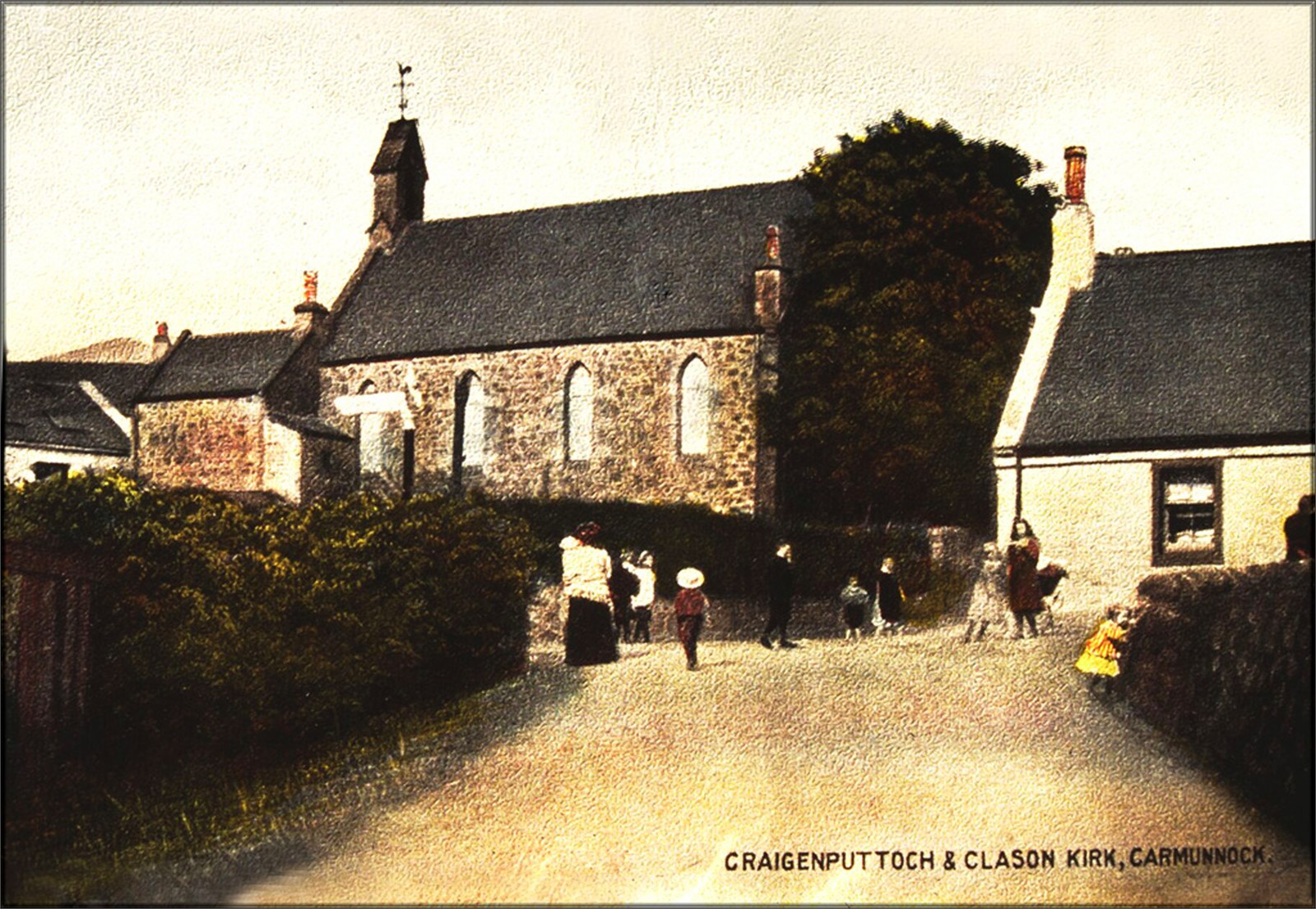
Ground was bought from Mr. Daniel McNiven for £40 in 1865, and soon the Clason Memorial Church - the Free Church - was opened, a simple structure in Early English Gothic style, built of rubblestone and squared sandstone facings. Note the interesting stonework below the little rose window in the bell-tower and the cross at the south end of the roof above a second little window; and on the same gable a chimney stack remains - perhaps from an early stove’s vent?
The long-ago vestry, a well-roofed little rubblestone building attached at the northwest corner, is now the hall’s outer kitchen room which for years was the main kitchen with a small scullery area at its south end where the vestry’s toilet had been. In early photographs all four of the tall Gothic-style windows are clearly seen; but since the 1950s the flat-roofed development which takes up the whole area in front of the main hall, not only includes the part built on for cloakrooms and cupboards, but the scullery area on the old kitchen’s south wall has been extended to make what is now the main kitchen, and the space that was at one time the most north-westerly of the hall’s four tall windows, has become the kitchen’s serving-hatch.
Founded as a Mission Hall now that the congregation of Busby Free Church (Busby East, 1865) was large enough to warrant an additional preaching station, the new Carmunnock building was named in honour of the Rev Patrick Clason, former minister of our parish church. Years earlier, he had become a supporter of the break-away from the Established Church - the Disruption of 1843. At the end of his ministry here, he had held services in Busby; then after moving to Edinburgh, the tall impressive-looking Dr Clason was appointed Clerk to the Assembly of the Free Church of Scotland.
The Disruption marked the outcome of years of dissatisfaction among many congregations throughout Scotland. It resulted from centuries under the law of Patronage by lairds who, carrying chief heritors’ powers, could dominate on all parish matters and had the right to be regarded as the only men fit to appoint the preacher. Then after much argument, unpleasantness and even bloodshed, with opinion decisively split, the Free Church of Scotland was formed. Its Kirk Sessions at long last had the freedom and power to decide on parish affairs and to elect a minister for their congregations - a right that came later to the Established Church of Scotland too.
Dubbed “the unco’ guid yins”, some families here had broken away and attached themselves to the Free Church, walking down to Busby in the early days before the Clason Church was built to accommodate them. However, most of the Establishment parishioners in Carmunnock seem to have been reasonably content. The Rev Adam Forman’s words in his account of the parish 47 years before the Disruption, are interesting. In his report he refers to “… the uniform attention which this family (the Lairds of Castlemilk) has ever paid to the parish in the choice of their pastors... The parish has always been kept together, so that there are very few dissenters.... and while the people have been satisfied, the Patron, by prudent address, has ever pleased himself and got the man of his choice”.
Perhaps significant is that the Free Church congregation in Carmunnock’s Clason Memorial Mission Hall never had its own minister and instead week by week, a preacher was supplied from Busby or Glasgow.