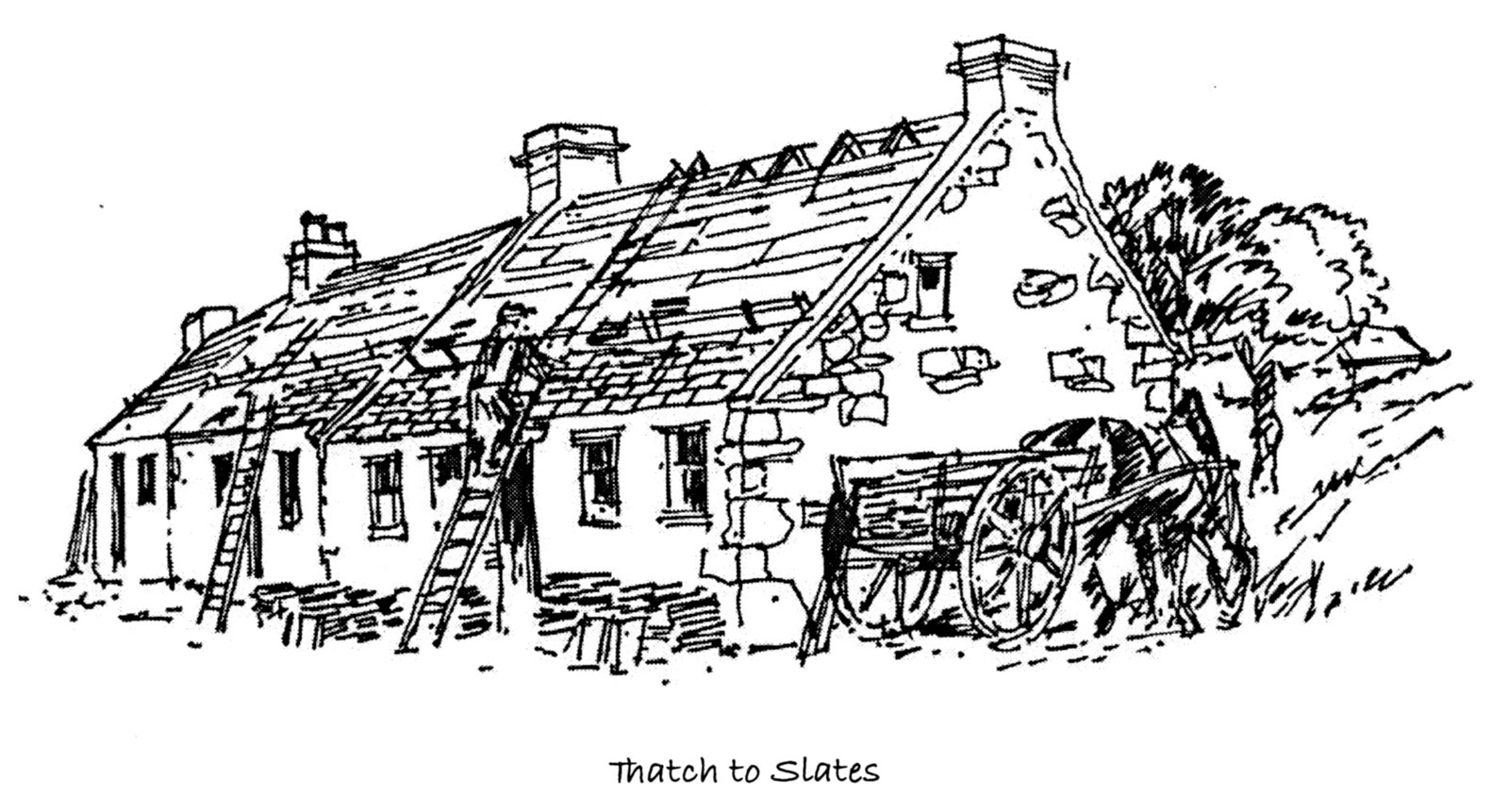
One particular job of work characteristically marked the beginning of the 20th century in Carmunnock. In 1901 the damp soot-blackened thack or thatch which for centuries had covered the roofs of the School Loan cottages was removed - in surprisingly good condition underneath. The old houses suddenly looked ruined and forlorn until the early coarse slates were laid, giving them another lease of life. Neighbours and friends, carrying out an old custom, kept fires burning in the hearths to continue the life of the home within its walls - from the old roof being removed to the new one being built on. Miss Janet Borland, till lately of Bankhead Road, born that same year (but who died in October 1987), remembered being told the story when she was a little girl.
The roofs of most other old cottages in the village were stripped of their thatch and slated around this time, including 22, 24 and Trestermyre at 26 Kirk Road where the Whyte family had lived for three generations. It is interesting to mention here that the Whytes were no longer portioner crofters but wheelwrights since the increase in the variety of conveyances.
As the years went on, many buildings whose roofs had been covered with stone tiles or big coarse slices of brown shale, were changed either to the slender or the heavy black slates. Mrs Begg, till lately of Stuart Road, told me that the 3-storey tenement on Main Street was slated in 1901 and probably the others in the row too. It was some years earlier that the roof of Jackson’s Lands - the Barracks - was done by Mr. Gray the builder (great-grandfather of Mr. George Gray of Waterside Road). The date of changing the coarse slates to the lighter modern ones on the village’s buildings varied from the 1920s to the 1960s.
Some property owners improved their houses for the tenants without being asked, and some tenants had to put into the Office (apply) to have work done. Upstairs rooms were made and dormer windows built out, but it is implied that in the Laird’s properties, the inhabitants of some of these repeatedly had to ask politely at the Castlemilk Estate Office to have improvements made. Older villagers tell us, quietly, that it “depended who you were, whether the Laird liked you or ignored you”.
The main structure of the Parish School on Waterside Road next to the Boghead Inn - built about 1840 and heightened in 1870 - was redeveloped at the front into a single-storey in 1904, with the addition of rooms for pupils and staff built on at the side and rear in the 1920s and 1950s. The days had arrived when lofty classrooms, plenty of fresh air and good clear daylight through tall windows were recognised as being highly beneficial. Happily, the nice stone brackets supporting the ledge mouldings above and below the windows were retained.
But now, with these changes to the building, there was no longer accommodation for the schoolmaster and Mr Rankin had to move his family into one of the houses next door in the block nowadays known as 111 and 113 Waterside Road.
On the far side of the School there was another big change. Although it had ceased to be a farm in the general sense, Boghead had nevertheless kept cows and sold milk for as long as anyone could remember. Mrs Mary Little (who lived until 1978), a teacher in Carmunnock School for many years, told us that as a child (Mary McNiven then) in the first years of the century, her mother sent her every day with a jug in one hand and a penny clutched preciously in the other, to buy milk at Boghead’s byre.
But as well as being a farm, Boghead had always been a change house and drinking house. Then, the Youngs who were the last farmers there, decided to sell the cows. Instead Boghead, in the Youngs’ tenancy, continued as a drinking house and hostelry. The Laird gave his permission for a licence; the building belonged to him and it suited him to have in his village an Inn where wayfarers could lodge.