With improvements in Glasgow’s steam laundries and the advent of electric washing-machines and drying facilities for wealthy households, Carmunnock’s washing industry began to fade out during the 1930s. No longer did Carmunnock greens hang with city customers’ fresh clean linen drying in the wind. And there were other gradual changes in the village’s appearance.
In the middle of the War the Craigenputtock Tearoom building was condemned and closed. With its roof off from 1945, the four walls in an increasingly dilapidated state stood forlornly on their little island till they were demolished and taken away. Then one day about 1948, Torrances’ cottage on Taits’ Garage area was knocked down and swept away in a matter of a few hours. The last thatched house in Carmunnock was no more. Local folk were becoming accustomed to big empty spaces in the centre of the village.
From the 1930s and 1940s, Lanarkshire County Council widened roads and junctions for the increasing traffic, and made good footpaths. Back at the beginning of the 1940s, Glasgow Corporation had bought Stephen Young’s passenger transport business and now city buses came up the hill hourly, running to and from Carlton Place on the River Clyde’s south bank just as Mr. Young had done. The Weys-box was still in use at this time, but two of the main Wells were defunct. Only at the Doo Well in its little fenced-off enclosure on Waterside Road and at Jackson’s or Mattha’s on Wellside did the pumps remain, and spring water flowed into stone troughs beside them.
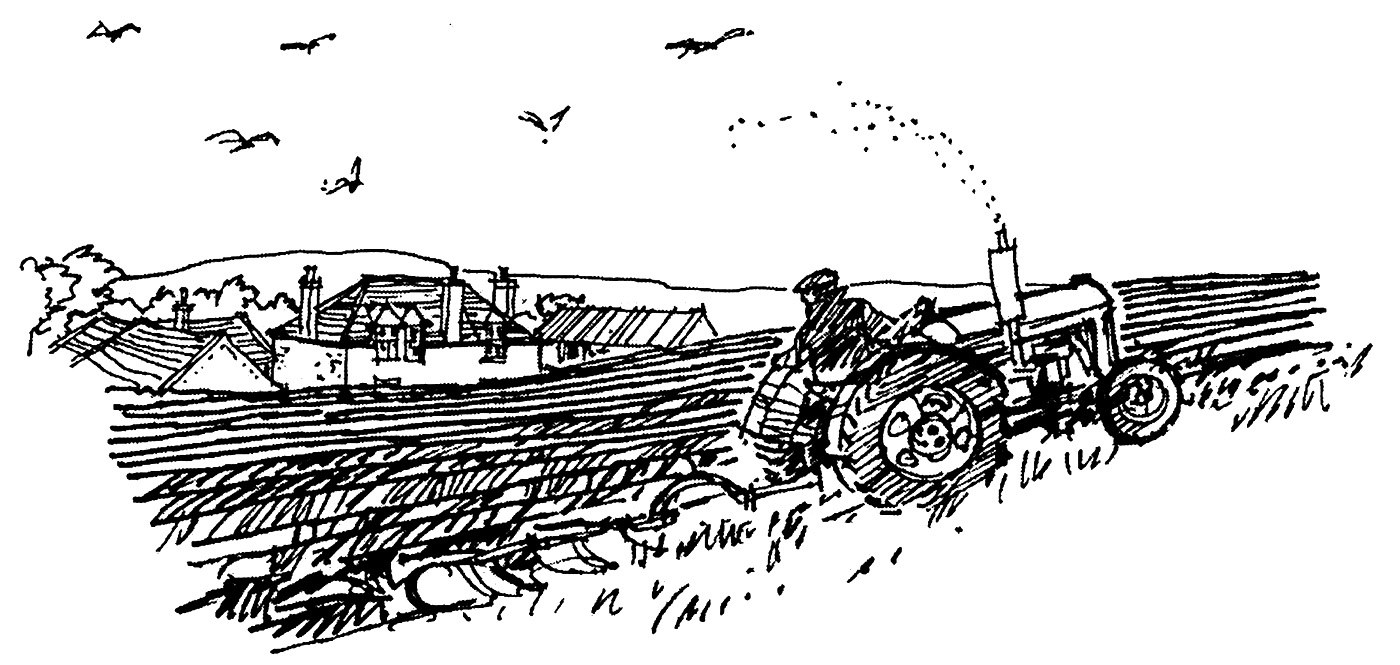
Much progress was taking place out on the farms too. Whereas for centuries farmers had depended on horses all year round from ploughing to reaping time, tractors were gradually taking over. Old Mrs Lawson till lately of Parklea Drive told me that her husband Alexander who had followed his father at Parklea, bought their first tractor in 1947. From then on, other apparatus too, she added, was starting to lessen the hard labour of dairy farming. Without any doubt milking by machine along with improvements for conveying the milk from shed to cooling and purifying systems, was soon to become a highly sophisticated operation.
Following the War, an effort was made by the Department of Health to house the increase in Glasgow’s population. Among many other sites, the Department acquired the Army’s old Anti-Aircraft and Searchlight Base, latterly a prisoner of war camp west of Mid Netherton Farm (where the relay aerial is now), planning to develop the huts and other buildings into temporary homes. Depressingly however, the plans didn’t materialise and the huts were taken over by squatters.
Up in Carmunnock all the Council houses had proper bathrooms and by now many of the longer-established houses did too, although from long habit a few hardy folk in the older buildings still washed themselves at a cold tap in the yard outside. But still more Council houses were needed and to add to the problem, poor conditions were beginning to make themselves sorely felt in several of the village’s tenements.
Tiny one and two-roomed houses in these and in the divided cottages, most of which had no indoor lavatory and had to share an outside one, were by this stage regarded as totally inadequate, especially for the bringing up of families, and the situation was becoming even more acute.
People had to find themselves accommodation wherever they could until, by the end of 1954, 31 harled brick Council houses built where Crofthill Playing Field had been were completed and in 1957 another block of four houses went up on the same area. Some folk had never in their lives had a home with so many rooms as they did now in these modern two and three-bedroomed houses. To serve this area of new Council properties, Carmunnock had two more roads: Stuart Road and Old Playing Field Road, both entered from the Glasgow or Netherton end of the village. In 1955, Stewarts’ Lands and the cottages at B’whinnie Corner were cleared away, leaving a wide grassy area at the bend of the road.
Ever since the 1950s, not only have improvements been made to the earlier Council houses, but conversions and developments to many of the village’s older buildings have been carried out to satisfy modern requirements. Once-divided cottages and some of the lands have long ago been bought over from landlords for private ownership, and made into either one complete residence, or two, or the tiny houses have been merged into larger ones, making fewer in the building than before.
Mrs Rita McNiven’s still excellent sweetie, toffee and lemonade shop, praised in past years by Macfarlane & Lang for good sales of their biscuits, was still open. But Miss Lamont’s general grocer’s shop in the 3-storey building, latterly run by a Mr. Macfarlane of The Beeches at Helena Place, had been taken over early in the War. Mr. and Mrs James Begg sold vegetables there now, and lived in part of the old tenement.
However, Rutherglen Co-operative (preceded by Avonbank’s who took over from Mrs Harper in the early 1930s) had moved out in 1936 when the building was condemned and set up shop in their new harled brick flat-roofed building where The Beeches cottages used to be. Together with Taggs’ grocers’, Post Office and paper shop, and with provision vans calling at customers’ doors, they supplied Carmunnock.
Happily, the name The Beeches hadn’t died. In place of The Craigenputtock, The Beeches Tearoom was opened in Drummond Place (in the part till recently still a tearoom) next to the butcher’s shop which had succeeded The Cathkin Rest. The village had never been without its pub, however; the Boghead Inn, a more private drinking house in the very early years, had long since become a public house and had welcomed the addition of The Cathkin Rest’s customers to its own already busy trade.
Old folk had died and retailing businesses in women’s houses ceased to exist. Even little lame Katie Clark at Millhill cottage retired during the War and passers-by on the road to or from Busby were sad to find the window in the lane closed. But the post-war period brought more visitors to the village on a day’s outing and shops that sold cigarettes and refreshments did well. Compared to today there was little traffic, although more people had cars now. For a while yet, Carmunnock up on the brae, far from the city din, would continue in its peaceful old-world way. The Census year 1951 counted the parish population at 1,316.
For centuries, the farmlands of the parish had belonged first to Lord Hamilton and then to the Stuarts’ Estate of Castlemilk. But, soon after the War began, Madam Stuart Stevenson decided to offer her farms for sale to their tenants. As early as 1940 Mr. Lawson bought Parklea; later, Mr. Strang bought Picketlaw farm; similarly Mr. Baird bought Gallowhill and several years afterwards Mr. Tom Mair bought Waterside’s. Most of the remaining land was Glasgow’s. Now, all that was left of the district’s old Estate in Madam’s name were the Boghead Inn (bought about 1971 by the breweries), Davielea and the High Green.