Perhaps we were fortunate to come here when we did. Carmunnock had, I think, altered surprisingly little despite a few clearances in the previous two decades. But the 1960s brought changes. The Rev Charles Harrison, minister of Carmunnock church since 1948, died in 1961. Before long, amid much argument, the decision was made to dispose of the handsome Georgian Manse declared beyond modernisation and in any case rotten with woodworm and dry rot. People here were scandalised when in 1965 the old building was sold for demolition. Soon, the square villa at the top of the Low Green being empty, Thorncliffe became the Manse and the newly ordained Rev Henry M. Gibson moved in.
Gallowhill Farm was still there when we came, bungalows across an unmade road north of it and semi-detached ones west of it. Mr. William Baird of this district’s well-known farming family, father of Mrs Jessie Jamieson of Ashtree, had died in 1934 and his son John, her eldest brother and his wife (Mrs Baird, till lately of Bankhead Road) continued the work. Later, when John died in 1953, the family carried on the farm for a little while more.
Then, in 1955 the farmhouse and most of the land was bought from the Baird family by Mr. John Coulter, with Mr. Millar managing the farm for him. But in 1964 the Coulters too sold out (living till lately in Windlaw Road) and in 1966 the fine square villa farmhouse and all the steadings were knocked down.
Mr. Coulter kept two or three of Gallowhill’s fields, however, leasing them to the Lawsons of Parklea; one of these - Coulters’ Field - on Cathkin Road at the foot of Trummle Brae was well known to us when Carmunnock’s Highland Games were held there in recent years. The rest of the land, namely the part round the one-time farm, was sold to Varney the builders.
On Trummle Brae there were three or four sizeable boulders or rocks lying interestingly at the top when we came. What, we wondered, had once been there? And till some years ago a wooden post stood a few yards from the same spot.
Matthew Connell had shod horses and done a variety of metal work well into the 1950s. But by 1965 Carmunnock’s last blacksmith had retired and Eastfield Smiddy on Cathkin Road closed.
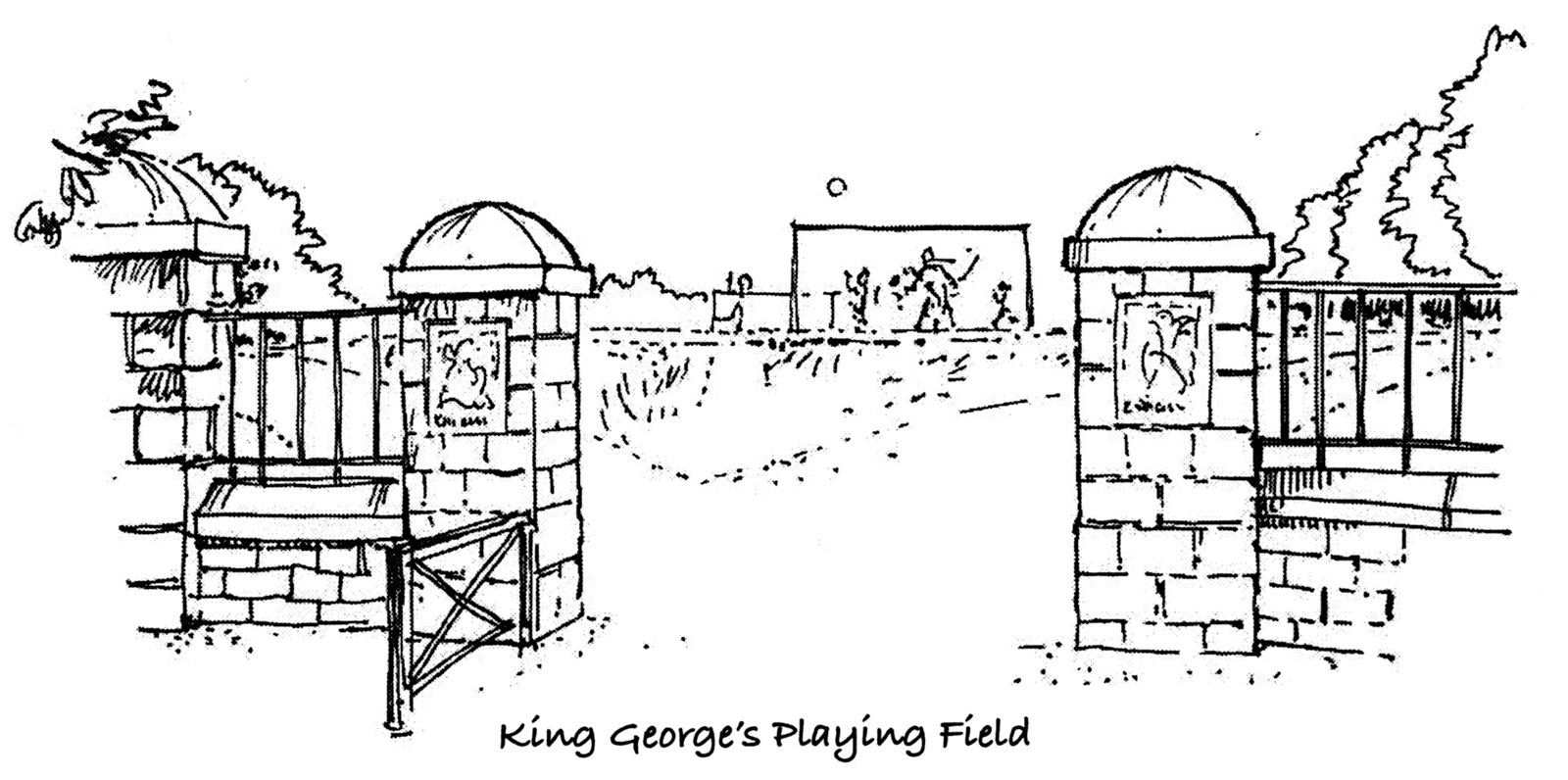
There were apparently several stages to the establishing of the new King George’s Field: first, its instigation in the late 1930s, then after the War it reverted from vegetables to playing field - or as the folk here said “from cabbages to kings” - and swings were put up near the entrance in the late 1940s or early 1950s.
Parents, remembering the Crofthill playground, complained that now the swings were too far away for their children and Sir Andrew McCance at The Craigs, who had not been pleased about the threat of house-building, wasn’t enthusiastic about the park either. This invasion, he was convinced, would bring roughness and noise; but he relented and later he generously contributed to the erection of a slide or chute; soon too there was a maypole, climbing bars and other constructions. The youngsters at least were delighted with their new play-area, boasting that now they shared the field with the village’s football team on their professionally marked-out pitch - because after the war Carmunnock Amateurs had been re-formed and was playing again in district League matches. On those Saturday afternoons, enthusiastic cheering by their supporters competed well with the Hampden roar heard from three miles away at Mount Florida!
To complete the move, it must have been in the late 1950s or early 1960s that the old Crofthill Park’s very handsome gate-pillars and gates were transported to the entrance of the new field. They had stood where the bollard-posts in Bankhead Farm’s back lane nowadays allow pedestrian access to Stuart Road. Hoisted intact onto a lorry, one gate-pillar broke in transit (and still shows this) but soon they looked well in their new royal location. Stone plaques showing the lion and the unicorn of the Royal Coat of Arms with the lettering “George V AD 1910-1936” and “King George’s Field” were set into each pillar. Then in 1961 the County Council made proper footpaths round the perimeter of the football pitch.
Castlemilk housing blocks were gradually spreading outwards from Croftfoot on the huge Corporation estate which was started in 1953 and nearing completion around 1964. By now the blocks high on the ridge were going up. For years the bus from Carmunnock to Glasgow - a 7d fare when we came - had taken us down the hill past High Netherton, Mid Netherton standing some distance away on our left, then down the slope past dilapidated and soon deserted Laigh or Lower Netherton Farm with its steading roof collapsing. The farmer still used the byre there and regularly the bus had to crawl slowly behind cows going into the farm or when they came ambling out at leisurely pace on their way to a field in what is now Lainshaw Drive.
Reproduced from the 1965 Ordnance Survey scale 1/2500, with the permission of the Controller of Her Majesty’s Stationery Office, Crown Copyright.
From the bus you could watch the new road being built a little down to our left, Holmbyre Road even further below. Opened about 1963, eventually it was developed into a big broad highway - a dual-carriageway - sweeping widely round the bend and on towards Dougrie Road. The ruins of Laighnetherton Farm between the old and the new road were swept away and some years later the Borlands who had been there (relatives of the ones at High Netherton) left the district. Even today a section of the old road remains just below the High Hagwell trees, unofficial path leading to the blocks above.
,p.Carmunnock Amateurs 1958/59
Back row l to r: A. Duffy (trainer), J. Traynor, J Little, M. Lambie, N. Martin, A. MacDonald,
D. Martin, J. Smith (manager). Front row l to r: D. Thomson, J. Harkins, A. Foster, E. Gethins,
I MacDonald. The team’s position in the Scottish Amateur League - Third top in the Fourth Division.
The Borland sisters of High Netherton Farm with Mr Jim Brown who had worked for them moved up to the village and the empty farmhouse in its square forecourt with steadings on both sides awaited the decision on its fate. Some months passed and then, like sweeping away a familiar old landscape, it was demolished in 1963.
Mid Netherton Farm on Glasgow City Council’s land continues, tenanted by Mr James McCoull. Back in the mid-1930s Carmunnock’s new cemetery close to this farm was marked out and consecrated. Perhaps it is unfortunate that its location beside the Castlemilk housing scheme is so far away from the village’s careful surveillance.
At this early 1960s stage, it was almost as though there was a deliberate effort to observe and record the old village before too many changes faded the picture away forever. I had the privilege recently of reading lecture scripts kindly lent to me, although these - both of the 1960s - are mainly about the church. And I have read interesting articles from The Hamilton Advertiser 1956 and The Rutherglen Reformer 1965. The latter also reports that the parish population in that year was 1,500.
Yes, the 1960s was certainly a time of many changes. Not only does progress bring sadness as old places are destroyed, but big new roads bring traffic, speed and petrol fumes. Situated at a point in the countryside where several roads converge on their way to other districts, Carmunnock streets soon had to take a big steady stream of all sorts and sizes of motor vehicles. There would be no going back now to the peaceful old days.
For just that reason I can’t resist taking a paragraph from one of these newspaper articles describing a pretty picture of exactly a century earlier when the mode of travel was so different. It was when in July 1868:
“the miller’s daughter of Dripps Mill at Waterfoot, Mary Ann Alexander, 19 years of age, in dark purple silk dress, got married in the snow-bright newly white-washed mill-house. The miller’s brae was packed to the road-end with gigs and traps, and as far as the eye could see ribbons bobbed on whips pointing skywards, little blobs of white against a blue sky and green hedge-rows. Guests made their way across the lade bridge to the porch and the ceremony took place in the parlour. There was dancing afterwards in the meadow to the tunes of the fiddler, before the bridal couple left in elegant carriage specially hired for the occasion, and eager little knots of cottage folk and their children gathered along the route to cheer them on their way”.
At the very end of our fast-moving decade, however, we had our own picture of Carmunnock’s earlier days. In 1970, in a great village effort to raise funds for the upkeep of the Castlemilk Hall, a gala week was held. There was a sponsored walk to Prestwick, a children’s concert, the Crowning of the Gala Queen, a football match, teas were served, there was a Whist Drive, a Grand Dance, and fireworks were let off.
Significantly, the Ratepayers’ Association and the Preservation Society’s contribution was a 3-day Exhibition. Interesting and informative photographs of old Carmunnock were lent and a variety of fascinating memorabilia of the village’s earlier years was gathered together.
So big and so valuable a show of these was collected in the Castlemilk Hall from all round our district that appointed people took turns of watching over it constantly. An overnight vigil was kept and while some of the watch slept on the draughty Hall floor, others kept guard. Everyone in Carmunnock, whether born and bred or newly come, enjoyed and learnt from the exhibition - but there were some very relieved conveners when all the items were safely back in their owners’ care again!