Castlemilk House, leased by the Stuarts to Glasgow Corporation, had been a Children’s Home under the Social Welfare Department’s authority for many years. But surrounded by the huge housing estate and constantly vulnerable to vandalism, the Corporation decided to demolish it in 1970-72. Historians and conservationists were horrified and angry. The long ago Queen Mary’s Room was destroyed and another door closed on this district’s history.
Although the handsome main gateway still stands at the corner of Mill Street and Croftfoot Road (between Rutherglen and Fernhill), all that is left of its drive into the east side of the old grounds leads from Tormusk Drive (off Tormusk Road) in Castlemilk housing estate. At the west side, the back gates - the white gates - probably originally on Dougrie Terrace which is to the back of Dougrie Road Police Station, survived for a time on Dougrie Drive between the present-day Health Centre and the bowling green. However, at the far end of Dougrie Road, off Castlemilk Drive, the avenue continues.
Today if you walk along this tree-lined drive whose entrance is between the Community Centre and the Swimming Pool, you come to the old stables and clock tower on your right. Shortly beyond, a children’s play area called Castle Towers incorporating the remaining lower walls of the original 15th century Castleton tower, marks the site of the historic mansion house.
Nearby, the drive approaching the House from the east side crosses a beautiful little stone bridge, happily preserved, spanning a fast-flowing stream leading down to the pond (long ago one of two artificial lakes kept stocked with fish). When all is quiet at this spot surrounded by tall old trees, housing blocks hidden behind them, you can try to imagine the ancient tower, the stateliness of the great mansion in its grounds and the grandeur of past days when the Castlemilk Stuarts were among the highest in the land.
So much demolishing and the sad disappearance of domestic and industrial establishments of historic interest was frightening, and so was the amount of building taking up the parish’s farming land and getting close to the village. And in spite of the Interim Order made in 1946 (in pursuance of the powers of the Town and Country Planning (Scotland) Acts of 1932 and 1943) for the preservation of trees, what happened that so many disappeared from the landscape - for instance the number once standing round the Netherton farms?
Carmunnock Ratepayers’ Association established many years earlier had almost fallen into non-existence when about 1961 it was hurriedly re-instated under the chairmanship of Mr R. W. Crawford because of threats to some of the village’s older buildings and as regards certain open areas. As time went on, however, several matters came up that it had no powers to deal with. For instance there was a suggestion in 1963 that the north Glebe land would be built on. Worried villagers protested strongly to the County Council and to the Church of Scotland in Edinburgh who owned it. Meetings were held, discussions took place and investigations were made as to how the necessary powers for keeping the land could be acquired.
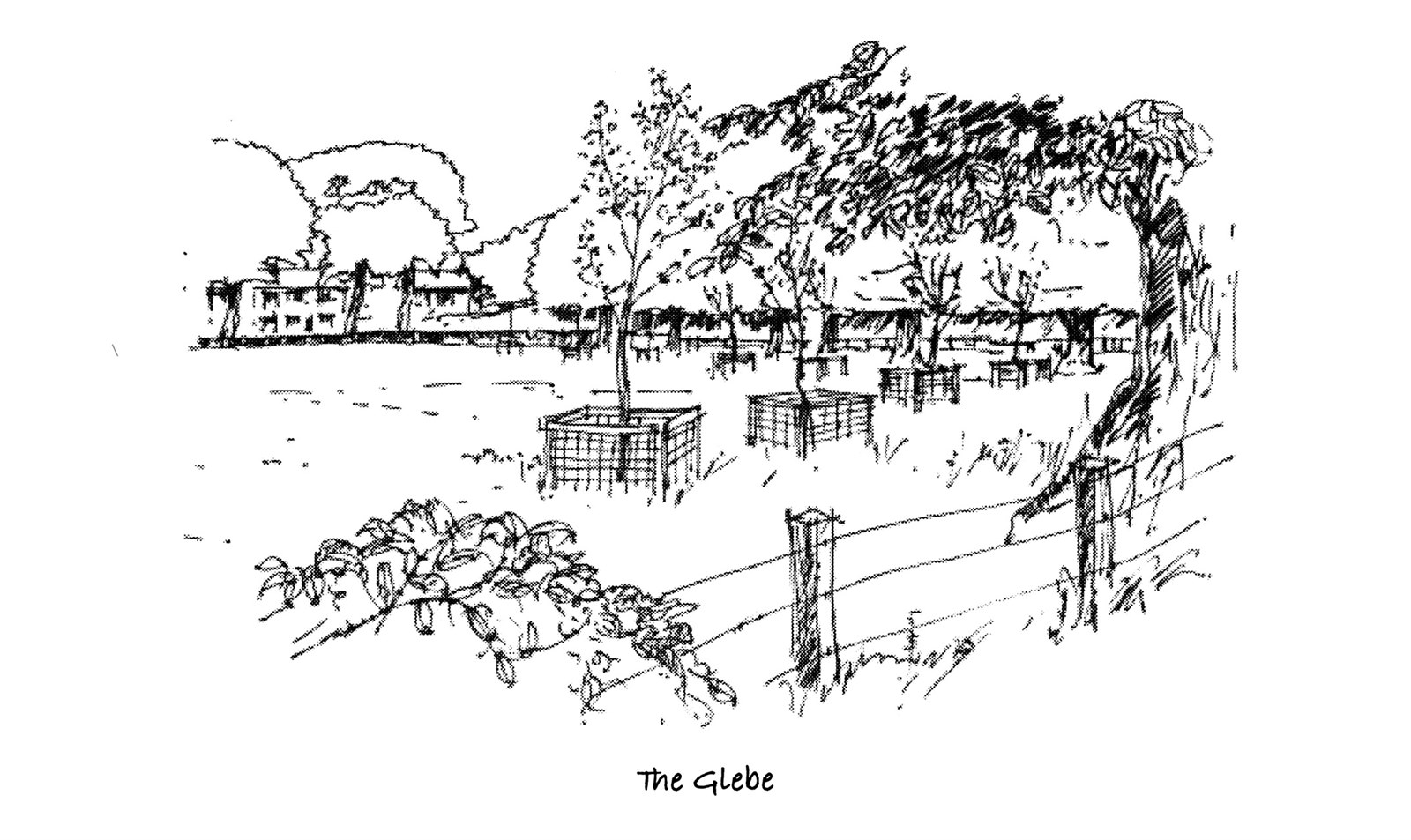
And so, in September 1964 Carmunnock Preservation Society was founded under the chairmanship of Dr Alastair Howie assisted by Mr Crawford of the Ratepayers’ Association. About 100 people undertook to contribute towards the sum of £4,500 necessary to buy the Glebe for the community to save it as farm land near the centre of the village. As the result of the founding of the Preservation Society, the National Trust for Scotland became interested and helped through the legal complexities; the Glebe land was secured and payment for it by instalments was completed by 1970. The land, being the property of the Society, is rented annually to the Lawsons of Parklea Farm for grazing use.
Soon afterwards, Mr. Cameron Carmichael (of Waterside Gardens) who is now the Vice-President of Carmunnock’s new Horticultural Society inaugurated in 1948, was instrumental in having Lanarkshire County Council donate 25 young trees and they were planted round the perimeter of the Glebe. A few years ago, however, some of these had to be renewed and this time money was granted by the Countryside Commission. Set in front of the mature trees there - to replace these at a later date - they ensure the rural picture for the future. The trees are of course also the Preservation Society’s responsibility, acting as it does on behalf of the village.
The new Preservation Society’s constitution stated that its object was the preservation of the architectural and historic character and atmosphere of the parish of Carmunnock and the improvement and safeguarding of such amenities. Besides giving the National Trust for Scotland a special place, from the outset the Society’s policy was to form good relationships with Lanarkshire County Council and the Planning Department and at meetings with these, our delegation put forward the views of residents of Carmunnock on matters of planning, conservation and amenity in general.
Another matter of immediate concern was the building in 1963 of a second storey on to The Neuk Restaurant (on the southwest corner of the crossroads in place of the former tearoom next to the Co-op’s store). It completely dominated the church. Two years later, however, The Neuk Restaurant was burnt to the ground and in due course Carmunnock Church, with some help from the Society, acquired the part of the site in question, thus preserving an open view of the church. Shortly afterwards, as a gesture for conservation, the Preservation Society supervised the laying out of this into a pleasant garden area.
As the result of local residents’ concern, tree preservation was another of the new Society’s aims. For instance in 1967 when the Gallowhill Farm site was being cleared for building, a plan devised a layout which saved the maximum number of trees there. Similarly in the Manse estate, Sycamore Way, many of the mature trees were preserved.
In these first few years since its institution the Preservation Society, now a well-established force in the village, working closely with the Ratepayers’ Association, had been very busy. There had been many meetings with the County Planning Department so that the latter now regarded the Society with considerable respect.
It was in mid-1969 that as a significant step forward, one of its committee, Mr. Clifford Delaney, purchased on the Society’s behalf the by then very derelict cottage-tenement in which had been Mrs McNiven’s confectionery shop on Kirk Road in the centre of the village.
David Miller the architect, formerly of Carmunnock, drew up plans. The National Trust for Scotland took an interest and a grant was obtained from Lanarkshire County Council. After gutting, reroofing, restoring and replanning by Thomas O’Brien the builders, the small semi-detached private residences now known as 2 and 4 Kirk Road were completed in 1974.
In European Architectural Heritage Year 1975, David Miller’s work for this Preservation Society project received the Scottish Civic Trust’s award, presented by Queen Elizabeth the Queen Mother at Edinburgh University’s St. Cecilia’s Hall. The two stone plaques replacing little windows - the one at the front in bas-relief depicting old world folk of 1798 and those of our modern day in 1974 round the tree of life - were designed and sculpted by the architect’s father the late Mr. Keith Miller.
Other buildings restored and replanned by David Miller at this time were the late 17th century Pathhead Cottages. A few years earlier the Society had hoped to purchase another property on Kirk Road; now it took an active interest in the restoration of houses in Manse Road, including the 1702 schoolhouse. Perhaps just in time after the 1960s burst of post-war progress, certain parts of Scotland were designated Conservation Areas under the Government’s Town and Country Planning (Scotland) Acts of 1947 and 1969 and the Civic Amenities Act of 1967.
In September 1970 the County Council declared Carmunnock Lanarkshire’s first Conservation Area - although this doesn’t appear to have become constitutional until 1974 - and from 1972 the village’s older buildings were listed, thus conserving them as of historic interest. Now strict care must be taken to preserve the original appearance of these buildings, trees must be protected and while giving due attention to the requirements of a growing population in a modern age, new buildings must be in keeping as much as possible with the environment.
No wonder there were celebrations as well as fund-raising events in that great year of 1970, manifested in the very fine exhibition of Carmunnock’s history.
The work continued. Together with the Ratepayers’ Association, the Preservation Society had done its utmost in 1969 to dissuade Madam Stuart Stevenson - up till that point the Society’s Honorary President - from selling her last bit of land in Carmunnock, namely the High Green (where the Whinstone Quarry, the coup and Crawfords’ joinery shops had been). The effort to preserve the area was supported by the National Trust for Scotland, the Scottish Civic Trust and by the Royal Fine Arts Commission for Scotland. In 1972 this solid front of protest was partially successful in ensuring that alterations to the original plans (which had been put forward by speculating builders) would conform with the environment. In 1976 two rows of houses - Cameron Crescent - built by Bovis Ltd. were completed.
The next dominating worry for the Ratepayers’ Association and the Preservation Society was that recommendations under the 1970 Wheatley Report on the Reform of Local Government in Scotland would transfer Carmunnock from one of natural rural environment in Lanarkshire to the urban setting and control of Glasgow. Carmunnock Amenities Association, a joint Committee, was set up to contest the proposal. Happily there was also support outside Carmunnock for its survival as a village in a green belt situation, not only for itself but in a recreational sense to the surrounding urban communities.
Committees met - once more under Mr Bob Crawford’s chairmanship - discussions were intense and the Secretary of State for Scotland was asked to amend the Local Government clause which placed Carmunnock in Glasgow. Our MP Mr. Gregor MacKenzie and other MPs were asked to support our case as was Lord Hughes and others in the House of Lords, and press coverage was given. By now it was the summer of 1973.
The case for Carmunnock had reached the highest lobbies in the land. And although the Local Government Bill became law despite the efforts for amendment, the Secretary of State advised an early application to the Boundaries Commission to have our case reviewed.
I have taken all this information, in brief form, from the Society’s booklet The First Ten Years by the three chairmen of those years, namely Dr A. J. Howie, Mr R. W. Crawford and Mr W. A. Crane.
Even when Regionalisation came and Glasgow decided to take Carmunnock into its District late in 1975 (there being too low a vote here to prevent this) and since the advent in 1998 of two-tiered local government, our case to preserve the green belt has so far been maintained - especially in a parish now much smaller since the post-war development of Castlemilk and East Kilbride.
Interest in the Ratepayers’ Association was beginning to fade once more, however, and to take its place it was at a Preservation Society meeting that a new Council for the community was suggested. Such things as Community Councils were a new thing. There were only a very few in Scotland when television and radio programmes aroused interest in those suggested for Cathcart and then for the village of Carmunnock.
In fact it was from the Carmunnock Amenities Association that a steering committee led, in time, to the forming of our Community Council in the later 1970s under the chairmanship of Mr Joseph Thomson of Kittochside Road at first, followed later by Mr John Crawford of Greenside. Then from 1982 Brigadier H. A. J. Jordan of Kittoch Mill became the Council’s chairman in its work of voicing villagers’ views to Glasgow District and now the City Council.
Throughout those years, Mr Derek Taylor our District Councillor from 1971-80, and Mr Gregor MacKenzie our MP from 1964-87, were good friends of Carmunnock, interested and helpful in the village’s welfare. Constant work is done by Carmunnock’s Community Council and the Preservation Society. Objections are made to undesirable plans for buildings in or close to the village, warnings are issued to owners of untidy sites, and industrial developments trying to establish themselves in a village amenity are not encouraged.
Attention is paid to landscaping, rights of way, the rural image and care of the countryside in our immediate vicinity. And perhaps most important of all, vigilance is constantly maintained by both committees against building contractors planning approach either from the Glasgow or the East Kilbride side of our green belt. On the Glasgow side, without a doubt the land held for Carmunnock by the Warnock Trust has its significance. And the Cathkin Braes Park was presented to the City in 1886 by Mr. James Dick, to be left in its natural beauty.
However, the persuasive and influential strength of some, or the inevitable power of local authorities, or even too little interest by villagers, sometimes means failure. Support for the rules of conservation by as many people as possible is therefore of the greatest importance.
Among the paragraphs in the last chapter of this long story, I refer to some of the changes and additions that have taken place in the village in recent years. While some of the plans which have been passed by the Planning Department may be regarded by a few as disputable, in most of them the desired care for good conservation is clear.
CARMUNNOCK PRESERVATION SOCIETY
MEMBERS OF COMMITTEE 1964-99
C = Chairman, VC = Vice Chairman, HP = Honorary President, HVP = Honorary Vice President, T = Treasurer, S = Secretary, MS = Minutes Secretary
Mrs D. Adam; Rev R. Anderson; R. G. Black; P. Brogan; W. A. Crane, C, HP; R. W. Crawford, C, S, HVP; Mrs M. Cargill, MS, S; Mrs R. J. Dalziel, S; D. Davidson; Mrs D. Davidson; C. J. Delaney, C, S, T; C. Dohelsky; Mrs I. Drury, S; D. Graham; J. Gray; Mrs N. Graham; Major E. G. L. Haigh; Mrs B. Herbert, MS, S; M. Herbert; Dr. A. J. Howie, C, HP; A. Hunter; A. Jamieson; J. Jarvie; Mrs I. Johnstone; M. Kelt; Mrs J. Kennedy; Mrs H. Lambie; R. M. Lambie; I. Lowdon; J. Marshall; A. Martin, T; K. Martin; M. Mason, VC; M. Mathieson; D. K. Miller, T; L. Miller; G. Mitchell; I. MacDonald; Mrs MacDonald; W. McAlonan, C; Mrs A. M. McDougall; R. G. MacGregor; Mrs C. MacPhail, C; J. MacWilliam; L. Ogilvie, T; J. Paterson; Dr I. Preston; R. Quin; Mrs A. Reid; Miss B. Rainey, MS; Mrs A. Rait; P. Rouse; Mrs P. Shanks, S; D. Smart; E. Smeeth; Madam Stuart Stevenson, HP; Mrs A. Watson; W. Cumming Watson; A. S. Weight; K. Wilkins; Mrs D. Worster; Dr K. H. R. Wright; E. M. Young.