Times long ago were grim. From the reign of Mary Queen of Scots, the troublesome Covenanting period and even during the years that followed, districts all over the country still bear names of sites where battles were fought, murders took place or hangings were carried out, as well as remembering less dramatic events.
In our vicinity, part of Big Wood had for centuries been known as “Hangman’s Wood”, Madam Stuart Stevenson used to say, telling an eerie story of his ruined cottage there. And on the north-east side of Carmunnock there is Gallowhill (or Gallows Hill) Road. At the south end of Gallowhill Road, on the right-hand side of Cathkin Road just as you leave the village, the low green slope on which it is said Druids worshipped in ancient times, came to be called Trummle Hill or Brae in the middle centuries - “trummle” being the Scots pronunciation of the word tremble.
While telling a number of stories, many say that a gallows stood on the hill and the victim, hands tied, was dragged to the top - gallows that were ultimately felled to the ground by victorious Covenanters. Elderly acquaintances tell us today that as youngsters playing around this spot, they called it “Tummle Hill”. Who knows: perhaps for generations the word had described where, at a signal, the foot-boards opened and the victim, neck held in hangman’s noose, ‘tummled’ to his death!
These names tell of dark old days, describing locations that aroused fear and trembling in many a heart at very thought of them. Once more old tales abound. Yet the name Trummle or Tummle Hill for instance, has survived into the present day. They say that for many a long year, the site remained a grim warning to would-be offenders of the law - and even as a threat to wayward youngsters!
But it is interesting that as time advanced, its “meaning” changed. It’s said that during the Napoleonic Wars the British flag was raised on Trummle Hill (as at many places throughout Britain then) to arouse patriotic fervour. Then in the 1914-18 War a locally-based contingent of soldiers hoisted the Union Jack at the top. Perhaps they raised the flag again at Victory time. In the early days threatening remarks such as “A’ll rin ye up the Trummle Brae”, or at the later time, urging men to enlist, “Get yersel’ up tae the Trummle flag!” were apparently heard long ago in the village.
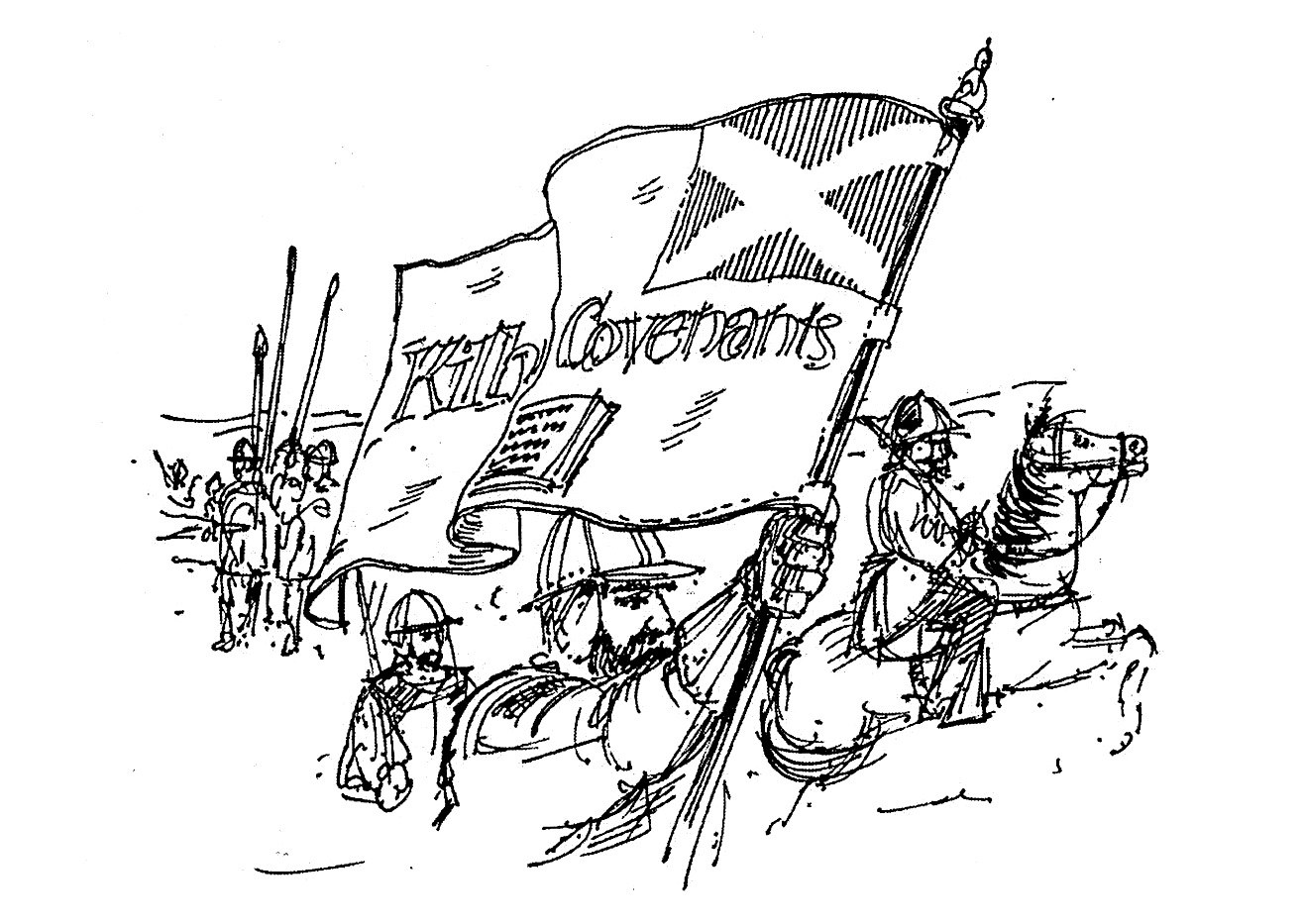
There may be many stories of happenings in or near Carmunnock. For instance, it is thought that a monk of some importance once lived, perhaps in hiding, in or close to the shelter of Pedmyre House in the turbulent 17th century. Two stories known to be true are about the Reids of Wester Kittochside bordering on our parish, who farmed there for 400 years. In 1599 they were cruelly attacked; their house was burnt down, looted, and a boy on the farm was injured when the Lairds of Caldwell in Renfrewshire demanded return of lands they had previously sold to the Reids. Several of this district’s historians have written descriptively of these incidences.
Eighty years later at the Battle of Bothwell Bridge, a descendant, James Reid of Wester Kittochside, was in command of the Kilbride Company, despondent at the Covenanters’ defeat. Although loyal to the King, he couldn’t bear to see the captured Kilbryd standard in Royalist hands and, drawing his broadsword, he charged their ranks single-handed. Managing to seize the flag, he tore it from its pole, wrapped it round his body and escaped from the field amidst a hail of bullets.
The Kilbryd flag, handed down in the Reid family from one generation to the next, was taken to America last century and then returned to its rightful home in Scotland in 1932. The famous flag was exhibited at Kelvingrove Art Gallery and Museum for many years although nowadays it is not on show.
In these more peaceful times, their distinguished Georgian house in East Kilbride parish, built in 1783, replaces their earlier home that was on or close to the same site. Interestingly, it was John Reid of Castlehill, Kittochside, of the same family who as a keen agriculturist, pioneered the “rummle” drain for this district in 1773. To improve crop-growing much field drainage was necessary and John Reid’s “rummle” system of layering stones and soil in a series of evenly-dug ditches was widely acclaimed, as was also his method of successful hedge planting for protection against the weather.